

Introduction
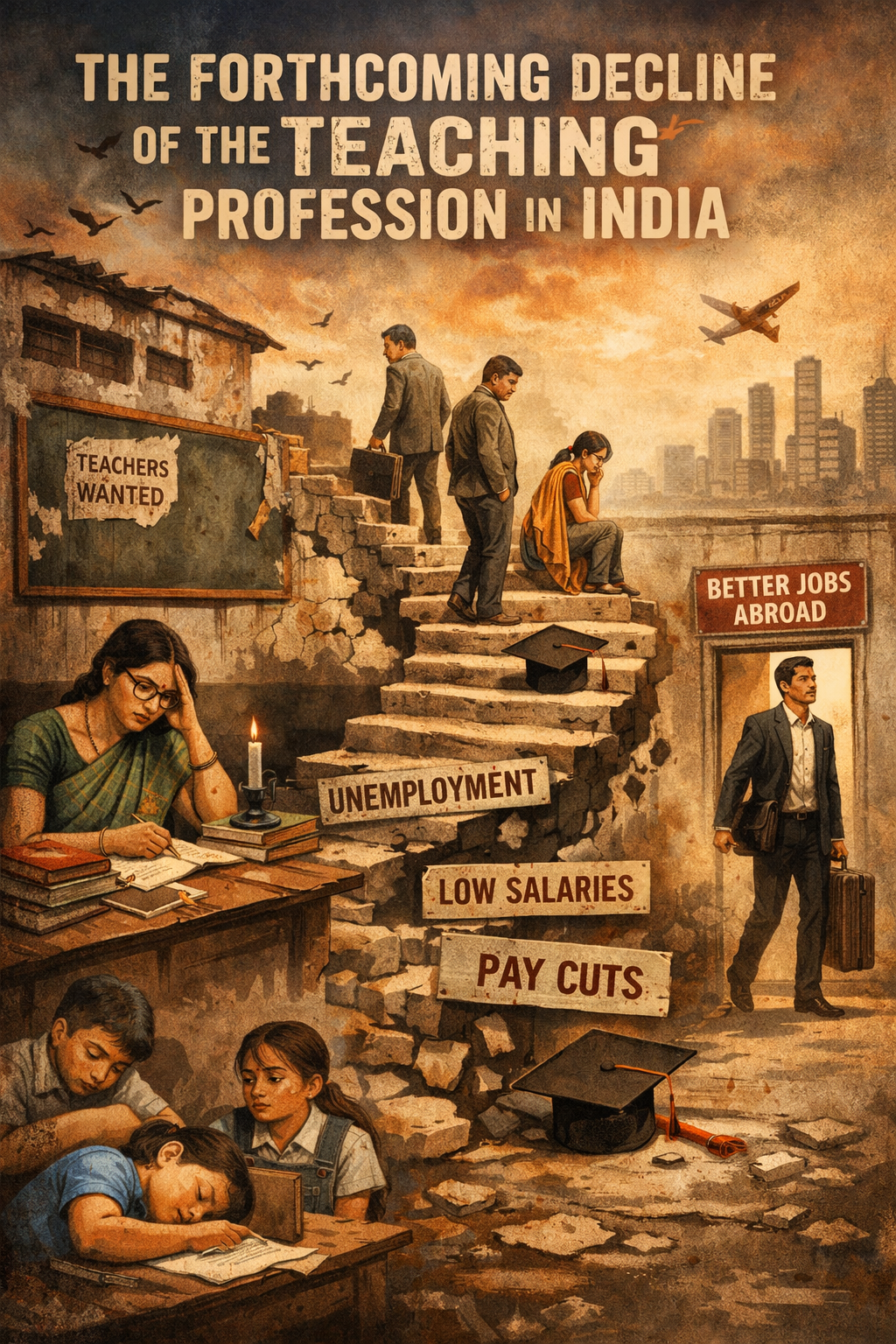
The teaching profession, long regarded as a cornerstone of nation-building, is undergoing a seismic shift. With rapid advancements in Artificial Intelligence (AI), evolving government policies, and the entry of foreign universities into the Indian education sector, the traditional role of teachers is at risk of significant decline over the next decade. This article explores the forces reshaping the teaching landscape and the implications for educators.
1. The Rise of Artificial Intelligence in Education
AI has emerged as a powerful force in personalizing education. Tools like adaptive learning platforms, AI tutors, and automated grading systems are increasingly replacing or reducing the demand for human teachers, especially in foundational and repetitive content delivery.
Impact:
-
AI-driven platforms like Unacademy, Khan Academy, and ChatGPT are offering 24/7 personalized learning, reducing student reliance on school teachers.
-
Subjects like math, coding, and language learning are now often taught more efficiently through AI platforms.
-
AI-powered tools also assess student performance in real-time, an area where human teachers struggle due to class sizes and limited time.
“AI won’t replace teachers, but teachers who use AI will replace those who don’t.”
— Andreas Schleicher, Director for Education and Skills, OECD
2. Government Policies: NEP 2020 and Beyond
India’s National Education Policy (NEP) 2020 aims to overhaul the education system. While it emphasizes teacher training and competency, it also promotes blended learning and digital education, further encouraging technology-driven models.
Impact:
-
Introduction of online and hybrid learning models reduces the need for large teaching staff.
-
The Academic Bank of Credits system allows students to choose online courses from multiple institutions, diluting the traditional classroom model.
-
Emphasis on skill-based learning shifts demand from traditional subject teachers to industry experts and mentors.
3. Entry of Foreign Universities
In 2023, the Indian government began allowing top foreign universities to establish campuses in India. Prestigious institutions like University of Oxford, MIT, and Stanford have shown interest in Indian expansion.
Impact:
-
Foreign campuses are likely to bring international faculty, online-first curriculum, and corporate partnerships that emphasize efficiency and output.
-
Many Indian universities and colleges may struggle to retain students and teaching staff due to the prestige and higher-paying roles in these global institutions.
-
There’s a growing preference for contract-based teaching roles and visiting faculty over permanent teaching positions.
“The permission for foreign universities to operate in India is a bold move, but it will redefine the status of Indian educators.”
— Dr. Raghunath Mashelkar, Former Director General, CSIR
4. Economic Realities and Social Perception
India’s teaching sector has long suffered from low pay, job insecurity, and a declining social status. With private edtech firms offering better salaries and working conditions, many young professionals are opting out of traditional teaching careers.
Trends:
-
Fewer students are enrolling in B.Ed. / B. Tech / B. Sc. programs.
-
Mid-career teachers are transitioning to edtech firms or freelance content creation.
-
The gig economy is reshaping education jobs, with tutors, influencers, and course creators replacing conventional teachers.
5. Future Outlook (2025–2035)
Unless restructured, the Indian teaching profession is likely to experience:
-
A 30–40% reduction in full-time teaching jobs in urban and semi-urban areas.
-
A rise in AI-assisted teaching roles, demanding both tech and pedagogical proficiency.
-
Emergence of “education facilitators” who manage AI tools rather than teach traditionally.
-
Institutional consolidation, where smaller colleges merge or shut down due to lack of faculty and student interest.
Conclusion
The next decade will redefine the role of educators in India. While AI and foreign collaborations promise innovation, they also pose an existential challenge to the conventional teacher. To survive, the profession must evolve—embracing technology, redefining its value proposition, and demanding systemic support through upskilling and regulatory reform.
“The teacher is not going away—but their role will be radically different. They will become mentors, not content providers.”
— Dr. K. Kasturirangan, Architect of NEP 2020

Dr. Irshad Ahmod Khan
Executive Director
Swatantrra Sahayak Foundation, Bhopal